|
Getting your Trinity Audio player ready...
|
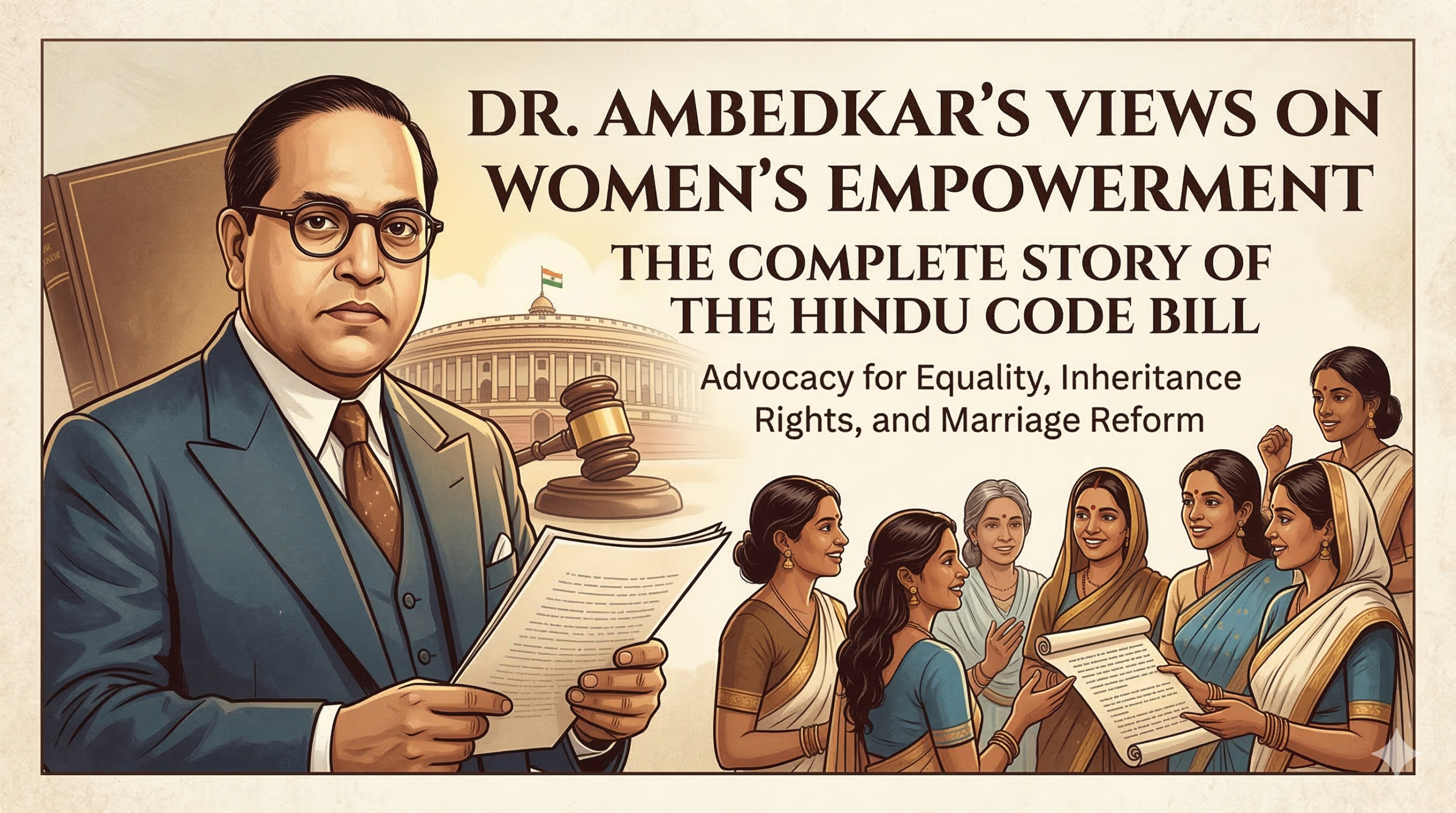
Dr. Ambedkar Views on Women’s Empowerment – The Complete Story of the Hindu Code Bill. The Man Who Staked His Career for Women’s Rights. Picture this. It’s September 1951. India is barely four years old as an independent nation. The Constitution has just been adopted, promising equality to every citizen. And yet, inside the Parliament, a fierce battle is raging — not about borders or budgets, but about whether Indian women deserve the right to divorce, inherit property, or marry outside their caste.
At the center of this storm stands one man — Dr. Bhimrao Ramji Ambedkar, India’s first Law Minister and the chief architect of the Constitution.
He has poured years of his life into drafting a single piece of legislation — the Hindu Code Bill — that could fundamentally reshape the lives of millions of women across the country. But powerful forces are lined up against him. Orthodox leaders call it an attack on Hindu tradition. Even the President of India opposes it. The Bill is being deliberately delayed, debated to death, and slowly buried.
And then, Dr. Ambedkar does something extraordinary. He resigns.
Not because he is tired. Not because he has lost hope. But because he refuses to be part of a government that, in his words, leaves the inequality between sexes — the very soul of an unjust social system — completely untouched.
This is the story of that resignation. This is the story of a revolution disguised as a legal document. And this is the story of how one man’s vision — decades ahead of its time — laid the foundation for every legal right Indian women enjoy today.
Let’s rewind and start from the very beginning.
Why Did Ambedkar Think Women’s Empowerment Was So Important?
To understand why Dr. Ambedkar became India’s most passionate advocate for women’s rights, you first need to understand how he saw the social structure of India.
Ambedkar didn’t view the oppression of women as an isolated issue. For him, the subjugation of women and the tyranny of the caste system were two sides of the same coin. He argued that the mechanism that kept the caste system alive — endogamy (marrying within one’s own caste) — was fundamentally about controlling women. If women had the freedom to choose their partners, own property independently, or walk out of oppressive marriages, the rigid walls of caste would naturally begin to crumble.
This was a radical insight for the 1940s, and it’s an idea that modern scholars now describe using the term “intersectionality” — the understanding that gender oppression and caste oppression are deeply intertwined and cannot be addressed in isolation.
At the All India Depressed Classes Women’s Conference in Nagpur on July 20, 1940, Ambedkar made his position crystal clear. He spoke about the transformative power of women’s organizations and emphasized that no community could truly progress unless its women were educated, empowered, and actively participating in the process of social change.
But Ambedkar was not a man who stopped at speeches. He believed that real change required legal force. And that’s exactly what he set out to create.
His track record in fighting for women’s rights even before independence was remarkable. As a member of the Bombay Legislative Assembly in 1938, he recommended making birth control facilities available to women — an idea considered almost scandalous at the time. He was instrumental in reducing working hours for women in factories, improving their working conditions, and pushing for the Mines Maternity Benefit Act, which demanded equal pay for women coal mine workers and guaranteed maternity leave.
For Ambedkar, women’s empowerment wasn’t a side project. It was the project — inseparable from his larger mission of annihilating caste and building a just society.
What Was the Hindu Code Bill? Understanding the Legislation That Shook India
Now, let’s talk about the legislation itself — the Hindu Code Bill. What exactly was it, and why did it cause such an earthquake in Indian politics?
Before independence, Hindu personal law was a patchwork mess. There was no single, unified code governing marriage, divorce, inheritance, or adoption for Hindus. Instead, different regions followed different traditions — primarily the Mitakshara and Dayabhaga schools of law — and these traditions were interpreted through centuries-old texts like the Vedas, Smritis, and Puranas. And guess what? Almost all of these interpretations heavily favored men.
Women had virtually no right to property. A widow could use her deceased husband’s property during her lifetime, but she couldn’t sell it, and after her death, it went back to the husband’s male relatives. Daughters had little to no claim on their father’s estate. Divorce was practically non-existent. Polygamy was legal for men. And inter-caste marriages were socially forbidden and legally unrecognized.
In short, for Hindu women, the legal system was a cage built from religious text and male privilege.
The idea of reforming this system wasn’t entirely new. The British had initiated some changes, like the Women’s Right to Property Act of 1937, but these were half-measures at best. In 1941, the government set up the B.N. Rau Committee to gather opinions and draft a comprehensive Hindu Code. The committee submitted a draft in 1944, but political upheavals — independence, partition — pushed it to the back burner.
After independence, Prime Minister Nehru entrusted the task of drafting the new code to Dr. Ambedkar. And Ambedkar dove in with everything he had.
The Hindu Code Bill, as drafted by Ambedkar, addressed seven critical areas:
- Property Rights: It abolished the concept of birthright to property and replaced it with survivorship. It called for giving daughters a half-share of property and converting women’s “limited estate” (where women could only use property, not own it outright) into absolute estate.
- Marriage Reform: It recognized “civil marriages” alongside traditional “sacramental marriages” and, crucially, removed the condition of specifying caste or sub-caste. This made inter-caste marriages legally valid.
- Monogamy: It declared that only monogamous marriages would receive legal recognition, effectively banning polygamy.
- Right to Divorce: For the first time, women were given the legal right to seek divorce on specified grounds — a concept that was completely alien to traditional Hindu law.
- Maintenance: It ensured that wives had the right to maintenance even if they chose to live separately from their husbands.
- Adoption: It abolished caste as a barrier in adoption and gave women greater rights in the adoption process.
- Guardianship: It recognized women — particularly mothers — as natural guardians of their children.
Ambedkar himself considered this Bill to be as important as his work on the Constitution. He understood that a constitution that promised equality was meaningless if the personal laws governing millions of women’s daily lives still trapped them in inequality.
Scholar Gail Omvedt later called the Hindu Code Bill a “Charter of Women’s Rights in Free India” — and it’s hard to argue with that description.
The Fierce Opposition: Who Stood Against Women’s Rights and Why?
If the Hindu Code Bill was so progressive, why didn’t it sail through Parliament? The answer tells you a lot about the India of that era — and, perhaps, about human nature in general.
The moment Ambedkar introduced the Bill, a firestorm erupted. The opposition came from all sides — and it was brutal.
The Hindu Mahasabha and the RSS treated the Bill as an existential threat to Hindu civilization. Their argument was that codifying Hindu law would destroy its inherent flexibility and sacredness. But the real fear, as Ambedkar saw it, was simpler: the Bill would destroy male supremacy, and that was unacceptable.
Jan Sangh leader Shyama Prasad Mookerjee issued public statements against the Bill, arguing that it would undermine Hindu culture. His rhetoric positioned the Bill not as a matter of justice but as an attack on tradition.
One saffron-clad religious leader went so far as to declare that an “untouchable” had no business interfering in matters that were traditionally the domain of Brahmins. The casteist underbelly of the opposition was always visible beneath its “cultural” arguments.
Even President Rajendra Prasad opposed the Bill. In what became one of the most revealing moments of the debate, Prasad argued that only “highly educated ladies” supported the Bill and claimed that his own wife would never support the divorce clause. This was presented as evidence that “ordinary” Indian women didn’t want these rights — a breathtaking piece of circular logic.
The RSS mobilized its cadres to protest in the streets of Delhi. They shouted slogans against Nehru and Ambedkar. On September 17, 1951, Swami Karpatri Maharaj led protests outside Parliament, resulting in lathi charges by the police.
Inside Parliament, some members argued that Hindu laws had remained unchanged since the Vedic period and that any modification was blasphemous. Misleading slogans were spread, including the false claim that the Bill would allow brothers and sisters to marry each other — a deliberate distortion of the Bill’s provision to remove caste barriers in marriage.
The debate on the Bill ran for more than fifty hours — likely the longest debate on any single bill in early Indian Parliament. And through it all, Ambedkar stood firm, patiently explaining every clause, countering every objection, and refusing to water down his vision.
But the political will to push the Bill through was simply not there.
The Resignation That Shook India: Ambedkar’s Ultimate Sacrifice
By 1951, it was clear that the Hindu Code Bill was being deliberately stalled. Despite Ambedkar’s repeated pleas to Nehru to advance the date for discussion, other legislative business kept being prioritized. The Congress party, facing a general election, was nervous about alienating its conservative base.
After months of painfully slow clause-by-clause discussion, the Bill was effectively shelved on September 22, 1951. Only four clauses had been passed. The rest was abandoned.
Ambedkar’s reaction was one of profound anguish. He described the Bill’s fate in unforgettable terms — calling it something that had been killed and left without mourning or remembrance.
Five days later, on September 27, 1951, Dr. B.R. Ambedkar submitted his resignation from the Nehru Cabinet.
In his resignation statement, Ambedkar articulated the core principle that had driven his entire fight. He argued that allowing inequality between classes and between sexes — the very foundation of Hindu society — to continue unchallenged, while passing economic legislation, was to mock the Constitution itself and build a grand structure on a rotten foundation.
This was not a resignation born of frustration. It was a moral rebellion. Ambedkar was making a statement to the nation — and to history — that women’s rights were non-negotiable, that no amount of political convenience could justify abandoning half the population to legal servitude.
What made the resignation even more poignant was Ambedkar’s observation about the silence of Indian women themselves. He noted with bitterness that very few prominent women leaders had come forward to support the Bill publicly. Bound by social fear, caste loyalty, and religious conditioning, many women could not — or would not — recognize that Ambedkar was fighting for their liberation.
It is one of history’s cruel ironies that the man who wrote the Constitution guaranteeing equal rights for all was denied the chance to give those rights to Hindu women through personal law.
After the Storm: How the Hindu Code Bill Finally Became Law
The story of the Hindu Code Bill doesn’t end with Ambedkar’s resignation. In many ways, that’s where the second act begins.
Nehru made the Hindu Code Bill one of his top campaign priorities in India’s first general elections of 1951-52. The Indian National Congress won a massive mandate — 364 out of 489 seats — while the Jan Sangh and Hindu Mahasabha won a combined total of just 7 seats. The Indian people had spoken, even if they didn’t know it, in favor of reform.
Nehru, now with a comfortable majority, adopted a clever strategy. Instead of re-introducing Ambedkar’s comprehensive Bill as a single piece of legislation (which had proven politically impossible), he split it into four separate Acts:
- The Hindu Marriage Act, 1955 — This established monogamy as the law for Hindus, provided grounds for divorce, and gave women the right to seek maintenance and judicial separation.
- The Hindu Succession Act, 1956 — This gave women, for the first time, the legal right to inherit property. (This Act was further strengthened in 2005, when daughters were made coparceners — finally realizing Ambedkar’s original 1951 vision.)
- The Hindu Minority and Guardianship Act, 1956 — This recognized women, especially mothers, as natural guardians of their children.
- The Hindu Adoptions and Maintenance Act, 1956 — This gave women the legal right to adopt children and ensured maintenance provisions.
Together, these four Acts essentially enacted the core of Ambedkar’s Hindu Code Bill — just in a different packaging. By the time these laws were passed, Ambedkar was no longer in the Cabinet. In fact, by 1956, he had renounced Hinduism and embraced Buddhism.
After Ambedkar’s passing in December 1956, even Nehru acknowledged his monumental contribution. The Prime Minister noted that Ambedkar would always be remembered for his relentless work on Hindu law reform and as a symbol of revolt against oppressive social structures.
The dream Ambedkar staked his career on had finally become reality — even if it took another government, another election, and another strategy to make it happen.
Ambedkar’s Legacy in Women’s Empowerment: Why It Matters Today
Fast forward to 2026. If an Indian woman today can own property in her own name, she can thank Ambedkar. If she can choose her own partner regardless of caste, she can thank Ambedkar. If she can walk out of an abusive marriage through legal divorce, she can thank Ambedkar. If she can adopt a child, be recognized as her child’s guardian, or claim maintenance from a husband who has abandoned her — all of these rights trace their roots back to one man’s stubborn, courageous, extraordinary fight.
And yet, there’s a troubling gap in public awareness. Mainstream feminist discourse in India has often overlooked — or underplayed — Ambedkar’s foundational role in the women’s rights movement. The Hindu Code Bill is rarely discussed in popular culture with the gravity it deserves. Many people know Ambedkar as the architect of the Constitution and as a champion of Dalit rights, but far fewer recognize him as arguably India’s most important feminist.
This is partly because Ambedkar’s feminism was intersectional before the word existed. He didn’t separate the fight for women’s rights from the fight against caste. He understood that the two oppressions fed each other and that dismantling one required dismantling the other. This made his feminism uncomfortable for those who wanted to talk about gender equality without talking about caste — and it still does.
Ambedkar’s influence also extended beyond the Hindu Code Bill. His foundational work influenced later legislation like the Dowry Prohibition Act of 1961, the Equal Remuneration Act of 1976, and the Hindu Succession (Amendment) Act of 2005 — the last of which finally made daughters coparceners, exactly as Ambedkar had envisioned in 1951.
His vision was not just about legal rights. It was about dismantling the ideology that justified women’s subjugation. He asked a question that remains profoundly relevant: If a religion or tradition cannot recognize the equality of women, is that religion or tradition worth defending?
Pro Tips: Understanding Ambedkar’s Women’s Rights Legacy
Tip 1: Read the Primary Sources. Ambedkar’s own writings and speeches on the Hindu Code Bill are available in Volume 14 of Dr. Babasaheb Ambedkar: Writings and Speeches, published by the Government of Maharashtra. These are freely available online and offer unmatched insight into his thinking.
Tip 2: Understand the Caste-Gender Link. You cannot fully understand Ambedkar’s feminism without understanding his analysis of caste. His essay Castes in India: Their Mechanism, Genesis and Development (1916) explains how endogamy — and therefore the control of women — is central to the caste system.
Tip 3: Look Beyond the Bill. Ambedkar’s contributions to women’s rights include his work on maternity leave, factory working conditions, birth control advocacy, and constitutional guarantees. The Hindu Code Bill was the centerpiece, but not the whole picture.
Tip 4: Compare the Original and the Final. Ambedkar’s original Hindu Code Bill was a single comprehensive legislation. Nehru’s four separate Acts made strategic compromises — for example, the Mitakshara joint family system was partially reinstated, and brothers were allowed to buy out daughters’ inheritance shares. Understanding these differences shows what was gained and what was diluted.
Tip 5: Connect Past to Present. The 2005 Amendment to the Hindu Succession Act, which made daughters coparceners, is a direct fulfillment of Ambedkar’s 1951 vision — more than 50 years later. Track these legislative connections to see how ahead of his time Ambedkar truly was.
Frequently Asked Questions (People Also Ask)
1. What was Dr. Ambedkar’s role in the Hindu Code Bill?
Dr. Ambedkar served as the chairman of the drafting committee for the Hindu Code Bill. As India’s first Law Minister, he was responsible for preparing, presenting, and defending the Bill in Parliament from 1948 to 1951. The Bill aimed to codify and reform Hindu personal law, giving women rights to property, divorce, maintenance, and equal inheritance. When the Bill was blocked by conservative opposition, Ambedkar resigned from the Cabinet in September 1951 as a protest against the denial of women’s rights.
2. Why did Ambedkar resign over the Hindu Code Bill?
Ambedkar resigned on September 27, 1951, because the Hindu Code Bill was deliberately stalled and effectively killed in Parliament after only four clauses were passed. He saw this failure as a betrayal of the Constitution’s promise of equality. In his resignation statement, he argued that leaving gender and caste inequality untouched while passing economic legislation was like building a palace on a rotten foundation.
3. How did the Hindu Code Bill empower women?
The Hindu Code Bill sought to empower women in multiple ways: it proposed giving women absolute property rights (instead of limited estate), making daughters equal heirs to their fathers’ property, banning polygamy, legalizing divorce, recognizing inter-caste marriages, granting women maintenance rights even during separation, and recognizing women as natural guardians of their children.
4. What is the connection between the Hindu Code Bill and the four Hindu Acts of the 1950s?
After Ambedkar’s resignation and the Congress party’s landslide victory in the 1952 elections, Nehru divided the original comprehensive Hindu Code Bill into four separate Acts — the Hindu Marriage Act (1955), the Hindu Succession Act (1956), the Hindu Minority and Guardianship Act (1956), and the Hindu Adoptions and Maintenance Act (1956). Together, these Acts implemented the core provisions of Ambedkar’s original Bill.
5. Why is Ambedkar called a feminist?
Ambedkar is considered a feminist because he dedicated a significant portion of his political career to securing legal rights for women. He fought for property rights, divorce rights, maintenance, and equal inheritance at a time when these ideas faced violent opposition. His understanding that gender oppression and caste oppression are interlinked makes his approach an early example of intersectional feminism. Scholar Gail Omvedt described the Hindu Code Bill as a “Charter of Women’s Rights in Free India.”
Conclusion: The Revolution That Changed India — Brick by Brick
Here’s the thing about revolutions — the real ones don’t announce themselves with trumpets and marching bands. They come disguised as legal clauses, as parliamentary debates, as one man standing alone in a room full of opponents and refusing to back down.
Dr. B.R. Ambedkar’s fight for the Hindu Code Bill was exactly that kind of revolution. It was messy, frustrating, politically costly, and — in the short term — a defeat. But in the long arc of history, it was the single most important legislative battle ever fought for Indian women’s rights.
Every woman who inherits property today walks on a path Ambedkar cleared. Every woman who chooses her own partner, who escapes an abusive marriage, who is recognized as her child’s guardian — she is living proof that Ambedkar’s vision was not just idealistic; it was prophetic.
The question for us — in 2026 — is not whether Ambedkar was right. That debate is settled. The question is whether we are willing to carry his vision forward. Because true empowerment isn’t just about laws on paper. It’s about changing the mindsets that made those laws necessary in the first place.
And that revolution, friends, is still a work in progress.
Share this post with your friends.