|
Getting your Trinity Audio player ready...
|
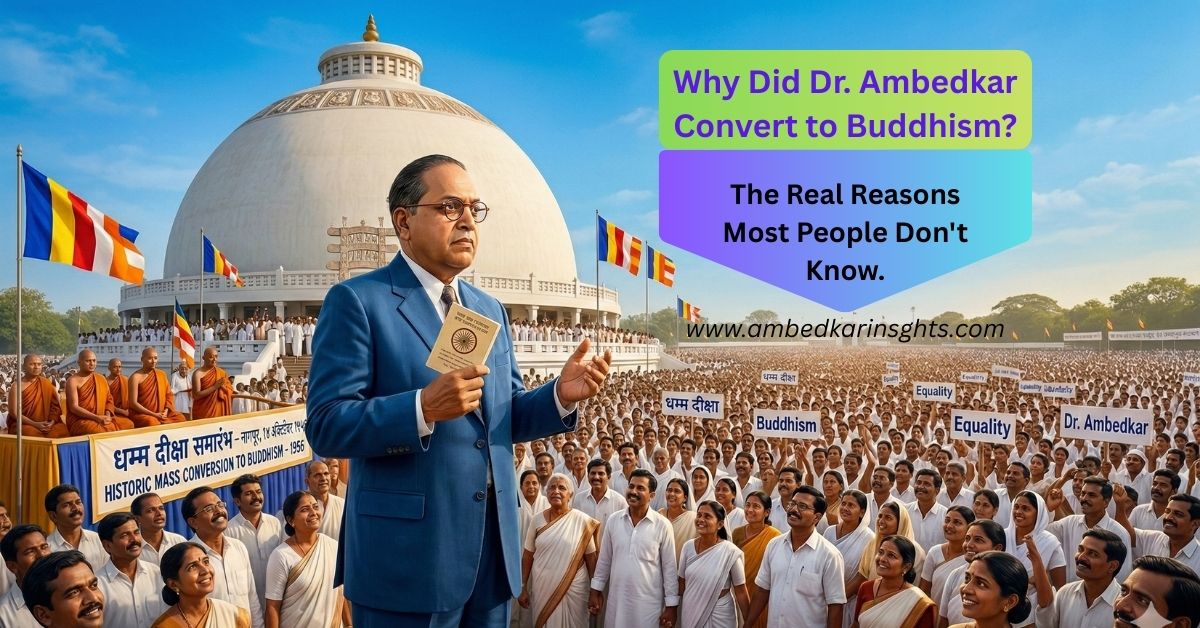
Why Did Dr. Ambedkar Convert to Buddhism? On October 14, 1956, something extraordinary happened at Deekshabhoomi in Nagpur that shook the very foundations of Indian society. A man who had drafted the Constitution of the world’s largest democracy — a man who had spent his entire life fighting against the chains of caste — stood before a crowd of nearly 5,00,000 people and made a decision that would change the course of history forever.
Dr. Bhimrao Ramji Ambedkar, along with lakhs of his followers, publicly embraced Buddhism, leaving behind the religion he was born into. This was not just a religious event — it was the largest mass conversion in modern history and the birth of the Neo-Buddhist movement in India.
But why did Ambedkar choose Buddhism? Was it just anger against Hinduism? Was it a political move? Or was there something much deeper — a lifelong intellectual journey that most people never talk about?
Let’s uncover the real reasons behind Dr. Ambedkar’s Buddhism conversion — the ones that history books often skip.
Who Was Dr. B. R. Ambedkar? A Brief Historical Background
Before we understand why Ambedkar left Hinduism, we need to understand the life that shaped his decision.
Born on April 14, 1891, in Mhow (now Dr. Ambedkar Nagar), Madhya Pradesh, Bhimrao Ambedkar was born into the Mahar caste — a community branded as “untouchable” under the rigid Hindu caste system. From his earliest childhood, he experienced brutal discrimination that left permanent scars on his consciousness.
He was not allowed to sit with upper-caste students in school. He could not drink water from the common tap. Even his teacher refused to touch his notebook. The world told him, at every step, that he was born inferior.
But Ambedkar refused to accept this. Against all odds, he rose to become one of the most educated Indians of his era. He earned degrees from Columbia University and the London School of Economics, was called to the Bar at Gray’s Inn, London, and went on to become the Chairman of the Drafting Committee of the Indian Constitution — India’s first Law Minister and the chief architect of its democratic framework.
Yet, no matter how many degrees he earned, no matter how high he climbed, caste followed him like a shadow. And this lifelong battle against caste injustice became the seed that eventually led him to Buddhism.
Ambedkar on Caste System: Why He Rejected Hinduism
The most widely recognized reason behind Ambedkar’s conversion to Buddhism in 1956 is his deep, well-documented rejection of the Hindu caste hierarchy.
Dr. Ambedkar did not see caste as merely a social problem. He saw it as a system religiously sanctioned by Hindu scriptures, rituals, and traditions. In his view, the sacred texts themselves provided the very foundation for inequality — making reform from within nearly impossible.
In his groundbreaking work “Annihilation of Caste” (1936), Ambedkar made his position devastatingly clear. He argued that caste could not be destroyed through social reform alone. It required a complete rejection of the religious framework that gave birth to it. He challenged the very roots of Brahmanical hierarchy and declared that as long as caste had religious sanction, no amount of legislation could truly eradicate it.
As early as 1935, at the historic Yeola Conference in Nasik, Ambedkar made a declaration that sent shockwaves across the nation:
“I was born a Hindu, but I will not die a Hindu.”
This was not an impulsive statement made in anger. It was a carefully considered resolution — one that would take over 20 years of deep intellectual exploration before it finally materialized at Nagpur in 1956.
Reasons Ambedkar Chose Buddhism: The Lesser-Known Truth
While the rejection of caste is the surface-level explanation most people know, the real reasons Ambedkar chose Buddhism were far more complex, layered, and intellectual. Let’s explore them one by one.
1. Ambedkar’s 20-Year Intellectual Journey Before Choosing Buddhism
After his 1935 declaration, Dr. Ambedkar didn’t rush into any conversion. He embarked on what can only be described as one of the most rigorous intellectual investigations in modern religious history.
For over two decades, he studied nearly every major world religion — Islam, Christianity, Sikhism, and Buddhism. He analyzed each religion’s philosophical foundations, its stance on equality, freedom, individual dignity, and its practical implications for the oppressed.
He rejected Islam and Christianity primarily because he felt they would culturally alienate his followers from the Indian context. These religions, associated in popular perception with foreign rulers and colonizers, could create a new set of problems rather than solving the existing ones.
Sikhism was seriously considered, but Ambedkar ultimately concluded that he needed a religion with a universal philosophical framework — one not limited by regional or ethnic identity.
Buddhism stood out above all others. It was born on Indian soil, deeply rooted in Indian culture, yet fundamentally opposed to the Brahmanical hierarchy that Ambedkar had fought against his entire life.
2. Buddhism’s Alignment with Liberty, Equality, and Fraternity
Dr. Ambedkar was profoundly influenced by the French Revolution’s ideals of liberty, equality, and fraternity — the same principles he had carefully woven into the Indian Constitution. What struck him deeply was a remarkable realization: the Buddha had preached these very values over 2,500 years before the French Revolution.
In Buddhism, there is no caste. There is no concept of high or low birth. There is no “chosen people” or “condemned people.” Every human being — regardless of their social origin — has the potential to achieve enlightenment through their own effort and moral conduct.
For Ambedkar, social equality in Buddhism was not an afterthought or a modern interpretation — it was the core of the religion itself. Buddhism was not just a faith to him — it was a complete philosophy of human emancipation.
In his masterwork “The Buddha and His Dhamma”, Ambedkar articulated that Buddhism was the only religion that gave equal emphasis to morality, compassion, and reason — without relying on the concept of an all-powerful God or supernatural authority that could be weaponized to justify inequality.
3. The Quest for Human Dignity Over Spiritual Salvation
Unlike many religious conversions throughout history that are driven by the promise of spiritual salvation or an afterlife reward, Ambedkar’s thoughts on religion were rooted in something far more practical — the pursuit of human dignity in the present life.
He was less concerned with what happens after death and more focused on the quality of life that people lived every single day. He saw Buddhism as a practical, this-worldly religion that addressed real human problems rather than abstract theological debates.
The Buddha’s core teachings focused on reducing suffering (Dukkha), practicing ethical conduct (Sila), and cultivating wisdom (Prajna). These were not otherworldly promises — these were actionable principles for living a dignified, meaningful life.
For millions of Dalits who had been systematically denied basic human dignity for centuries, this philosophical shift was nothing short of revolutionary. Buddhism told them: Your worth is not decided by your birth. It is decided by your actions, your character, and your compassion.
4. Political and Social Empowerment of the Dalit Community
Ambedkar understood something that many people overlook even today — religion in India is not just a spiritual matter; it is a political and social identity. The religion you belong to determines your place in the social hierarchy, your political representation, and even how others treat you in daily life.
As long as Dalits remained within the Hindu fold, they would always occupy the bottom of the hierarchy — no matter how many laws were passed, no matter how many constitutional protections existed. The social stigma of being “lower caste” within Hinduism would persist regardless of legal equality.
By converting to Buddhism, Ambedkar aimed to give the Dalit community a completely new collective identity — one entirely free from the centuries-old stigma of untouchability. It was an act of political self-determination as much as a spiritual choice.
He firmly believed that without a fundamental change in religious identity, the psychological chains of caste would never truly break. Buddhism offered Dalits not just a new faith, but a powerful new sense of self-respect, pride, and belonging that the old system had systematically denied them.
5. Reclaiming India’s Lost Buddhist Heritage
This is perhaps the least discussed reason, and yet one of the most powerful.
Ambedkar was not a casual reader of Buddhism. He was a deeply committed scholar who spent years studying Pali texts, the Tripitaka (the Buddhist canon), and the history of Buddhism in India. He knew that Buddhism had once flourished across the Indian subcontinent — from the time of Emperor Ashoka to the great universities of Nalanda and Vikramashila.
He also understood how Buddhism had been systematically destroyed in India by Brahmanical forces over the centuries. For Ambedkar, embracing Buddhism was not adopting a “foreign” religion. It was an act of reclaiming India’s own lost egalitarian heritage — a heritage that had been deliberately erased from the nation’s collective memory.
Myths vs Real Reasons: Clearing the Misconceptions About Ambedkar’s Conversion
There are many myths and misconceptions that continue to surround Dr. Ambedkar’s conversion to Buddhism. Let’s separate fact from fiction once and for all.
| Myth | Reality |
| Ambedkar converted out of anger and frustration against Hindus. | His conversion was the result of 20+ years of rigorous study, deep reflection, and careful intellectual reasoning. |
| He was influenced or funded by foreign forces to convert. | Buddhism is an Indian-origin religion. There was absolutely no foreign influence involved. |
| It was a sudden, impulsive decision. | He publicly announced his intention in 1935 and converted in 1956 — a deliberate gap of 21 years. |
| He wanted to divide Hindu society for political gain. | He wanted to liberate oppressed communities from a system that denied them basic human dignity. |
| The conversion was only symbolic with no real impact. | It sparked the largest mass conversion in modern history, gave birth to the Neo-Buddhist movement, and permanently reshaped Dalit identity in India. |
The Nagpur Conversion Ceremony 1956: The Day That Changed History
On October 14, 1956, at the sacred ground of Deekshabhoomi in Nagpur, Dr. Ambedkar formally embraced Buddhism in a ceremony led by the revered Buddhist monk Mahasthavir Chandramani.
He first took the Three Jewels (Triratna — Buddha, Dhamma, Sangha) and the Five Precepts (Panchsheel) of Buddhism, formally entering the Buddhist faith.
Then, in an act of extraordinary historical significance, he turned to face the massive gathering and administered the same vows to an estimated 5,00,000 followers who had traveled from across India for this moment. The sight was breathtaking — hundreds of thousands of people simultaneously declaring their freedom from a system that had oppressed them for millennia.
But Ambedkar went one powerful step further. He formulated and administered 22 special vows — known as the Ambedkar 22 vows — to his followers. These vows included pledges to:
- Reject caste discrimination in all its forms
- Treat all human beings equally regardless of birth
- Follow the Noble Eightfold Path of the Buddha
- Renounce rituals and beliefs that perpetuate inequality
- Strive for knowledge, compassion, and moral living
These 22 vows were not merely religious commitments. They were a social revolution wrapped in spiritual language — a practical blueprint for breaking free from centuries of mental and social bondage.
Impact of Ambedkar’s Buddhism Conversion on Indian Society
The ripple effects of Dr. Ambedkar’s conversion continue to shape India even today. Here’s how his historic decision transformed the nation:
A New Identity for Millions of Dalits: For the first time in history, Dalits had a religious identity that did not place them at the bottom of any hierarchy. Buddhism gave them something priceless — pride, self-respect, and a sense of genuine belonging.
Birth of the Neo-Buddhist Movement in India: Ambedkar’s conversion gave birth to the Navayana (Neo-Buddhist) movement, which continues to grow across India. Today, millions of people across Maharashtra, Uttar Pradesh, Madhya Pradesh, Karnataka, and other states identify as Buddhists because of his legacy.
A Cultural and Literary Renaissance: The conversion inspired a powerful wave of Dalit literature, art, music, and intellectual thought. Writers like Baburao Bagul and Namdeo Dhasal, thinkers like Kancha Ilaiah, and countless artists drew direct inspiration from Ambedkar’s Buddhist philosophy to create works that challenged the status quo.
Global Recognition and Revival of Indian Buddhism: Ambedkar’s unique interpretation brought Indian Buddhism back to global attention. Today, Deekshabhoomi in Nagpur stands as one of the most visited Buddhist pilgrimage sites in the world, attracting visitors from across Asia and beyond.
Inspiration for Social Justice Movements Worldwide: Ambedkar’s decision to use religious conversion as a tool for social liberation has inspired marginalized communities far beyond India’s borders. His philosophy is studied in universities from Columbia to Oxford, and his legacy continues to influence human rights movements globally.
Relevance of Ambedkar’s Decision in Modern India: A 2026 Perspective
More than six decades after his conversion, a critical question demands our attention: Are Ambedkar’s ideas still relevant in modern India?
The honest answer is — perhaps more than ever.
Look at India in 2026. Caste discrimination, though legally abolished by the very Constitution Ambedkar drafted, still exists in countless forms — in marriages, in employment, in education, in housing, and even in everyday social interactions. Honor killings over inter-caste marriages still make headlines. Caste-based violence still shocks the nation. The very problems Ambedkar identified over seven decades ago continue to persist beneath the surface of modern India.
Ambedkar’s conversion was never just about changing religion. It was about changing mindsets. It was a bold, courageous message that no human being should ever accept a system that treats them as inferior by the accident of birth. It was a call for reason over blind faith, for dignity over tradition, for equality over hierarchy, and for self-respect over submission.
In an era where identity politics, social justice, and human rights dominate global conversations, Ambedkar’s decision to embrace Buddhism feels not just relevant — it feels prophetic.
Conclusion: A Final Reflection on Dr. Ambedkar’s Legacy
Dr. Ambedkar’s conversion to Buddhism was not an act of rebellion — it was an act of liberation. It was not born from hatred — it was born from a lifetime of love for justice and human dignity.
It was the culmination of decades spent fighting injustice, studying the world’s greatest philosophies, and searching for a path that truly honored the values of liberty, equality, and fraternity — values he had enshrined in the Indian Constitution for all citizens, yet which his own community was still denied in practice.
He didn’t just change his religion. He offered millions of oppressed people a completely new way to see themselves — not as outcasts of an unjust system, but as dignified, free human beings deserving of the same respect and opportunities as anyone else.
As Dr. Ambedkar himself beautifully said:
“Unlike a drop of water which loses its identity when it joins the ocean, man does not lose his being in the society in which he lives.”
His conversion to Buddhism was his final and most powerful act of ensuring that no human being should ever have to lose their identity, their dignity, or their self-respect — in any ocean, in any society, in any era.
The question is not whether Ambedkar’s decision was right. The question is — have we, as a society, truly understood the depth of what he was trying to tell us?
If you found this article insightful, share it with someone who deserves to know the real story behind one of the most important decisions in Indian history.
Frequently Asked Questions (FAQs)
Q1. Why did Dr. Ambedkar convert to Buddhism? Dr. Ambedkar converted to Buddhism because he believed the Hindu caste system was religiously sanctioned and could not be reformed from within. After 20 years of studying world religions, he found Buddhism’s philosophy of equality, compassion, and reason most aligned with his vision of social justice.
Q2. Why did Ambedkar choose Buddhism over Islam and Christianity? Ambedkar rejected Islam and Christianity because he felt they would culturally alienate his followers from the Indian context. Buddhism, being born on Indian soil and fundamentally opposed to caste hierarchy, was the natural choice.
Q3. What are the 22 vows of Dr. Ambedkar? The 22 vows are pledges Dr. Ambedkar administered to his followers during the Nagpur conversion ceremony in 1956. They include commitments to reject caste, treat all humans equally, follow the Buddha’s Eightfold Path, and renounce rituals that promote inequality.
Q4. When and where did Ambedkar convert to Buddhism? Dr. Ambedkar converted to Buddhism on October 14, 1956, at Deekshabhoomi in Nagpur, Maharashtra, along with approximately 5,00,000 followers.
Q5. What is the Neo-Buddhist movement in India? The Neo-Buddhist (Navayana) movement was born from Dr. Ambedkar’s mass conversion in 1956. It represents a modern interpretation of Buddhism focused on social equality, human dignity, and the empowerment of marginalized communities in India.
Share this post with your friends.